










In the dynamic theatre of construction, scaffolding is the essential stage that allows workers to perform safely at height. While we often picture the familiar tubular frames, a critical and often understated component of this system is the scaffolding prop. Also known as adjustable props, trench struts, or simply acrow props (after a popular brand name), these versatile tools are the workhorses of temporary structural support. They are the silent guarantors of stability, holding up the show until the permanent structure is ready to take the load.
Primary Types and Their Functions
Scaffolding props are primarily adjustable steel columns used to provide temporary support to horizontal elements like slabs, beams, and formwork, or to shore up walls and trenches. They fall into two main categories:
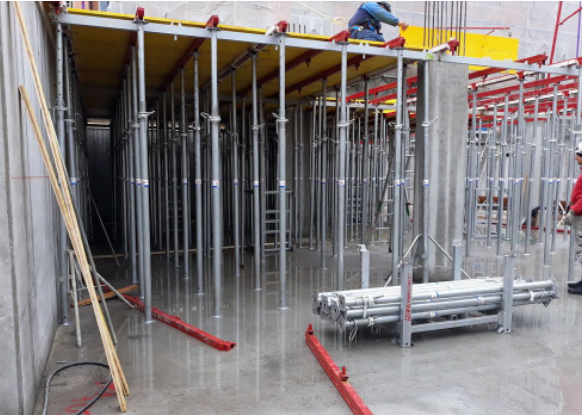
Vertical Load-Bearing Props: These are the most common type. They consist of two telescopic steel tubes—an outer sleeve and an inner extension—perforated with a series of holes. A pin is inserted through aligned holes to set the approximate height, with fine adjustment provided by a threaded screw and collar at the top. They are designed to carry high axial loads (forces running straight down their length) and are the go-to solution for supporting concrete formwork during casting and curing. You’ll see forests of these props in a multi-story building under construction, holding up the freshly poured floor above.
Raking or Flying Props: Unlike their vertical cousins, these are installed at an angle. They are used to transfer loads diagonally from a higher point on a structure to a solid base, often to stabilise walls, resist lateral forces, or provide support where a vertical prop is impractical. For example, when a new basement is excavated adjacent to an existing building, raking props are crucial for shoring up the existing foundation and preventing movement.
Material and Design: Built for Strength
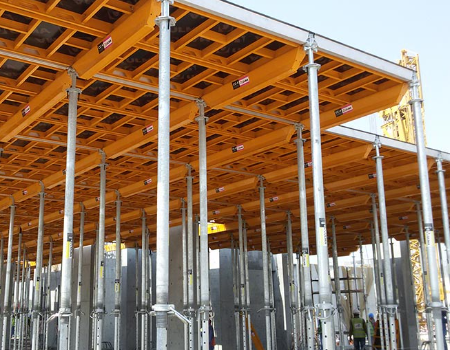
Modern scaffolding props are almost exclusively made from high-strength steel, typically galvanised to resist corrosion on busy, long-duration sites. Their design is a marvel of simple engineering:
The outer tube is usually larger in diameter and bears the majority of the compressive stress.
The inner tube slides inside, allowing for height adjustment.
The adjusting screw and collar provide the critical final precision, ensuring the prop is "snug" and bearing its share of the load effectively.
The base plate and head plate increase the bearing area, distributing the load onto the ground or the supported member to prevent localised damage.
Props are rated by their safe working load (SWL), which varies with their extended height. A general-purpose prop might have an SWL of 20kN (roughly 2 tonnes) at its minimum height, decreasing as it is extended. For heavier duties, heavy-duty and extra-heavy-duty props with thicker steel walls are available.
Key Applications on Site
The versatility of scaffolding props is demonstrated in their wide range of applications:
Slab Formwork Support: Their most classic use, creating a temporary grid to hold plywood decking and wet concrete.
Beam and Cantilever Support: Providing focused support under deeper concrete beams or protruding cantilevered sections.
Structural Alterations: Temporarily supporting walls, lintels, or roof structures during door/window enlargements or wall removals, a common sight in renovation projects.
Trench Shoring: In their horizontal configuration, as trench struts, they prevent soil collapse by bracing the walls of excavations for pipelines or foundations.
Emergency Shoring: Used by rescue services to stabilise structures after events like fires or earthquakes.
Safety: The Non-Negotiable Priority
The simplicity of props belies the need for strict safety protocols. Improper use is a leading cause of structural collapses on site. Critical safety measures include:
Competent Design: Props must be part of a load-bearing shoring design created by a competent engineer, calculating loads, prop spacing, and layout.
Correct Installation: They must be installed plumb (vertical) or at the designed angle, on a firm, level base. The adjusting screw should never be extended beyond its safe limit.
Adequate Bracing: Props, especially when used in rows, must be laterally braced together to prevent buckling—a chain is only as strong as its weakest link, and a grid of props is only as stable as its bracing.
Regular Inspection: They must be checked before use, during work, and after any event that could affect stability, like a storm. Damage, severe corrosion, or bending are grounds for immediate removal.
Conclusion
Scaffolding props may not be the most glamorous part of a construction site, but they are indispensable. They embody the principle of "temporary but critical." From the nascent floor of a skyscraper to a homeowner's renovated living room, these adjustable steel pillars shoulder immense responsibility. Understanding their types, uses, and, most importantly, the rigorous safety culture that must surround them, is fundamental to ensuring that the construction process not only progresses upwards and outwards but does so on a foundation of unwavering safety and stability. They are, quite literally, the props that hold up the scenes of our built environment.

